Preppy Bedroom Ideas That Look Grown-Up, Not Dorm Room
Preppy goes wrong when the brights take over. Four walls of hot pink with a pile of novelty pillows is a dorm room, not a tailored one.
Ground the room in crisp classic neutrals first, pure white, soft cream or a warm beige trim, and let those hold every large surface. Layer traditional pattern next, ticking stripe, micro-gingham, piping or toile, but keep it to two scales maximum.
Three competing scales is where the noise starts. Add warm natural texture, honey wicker, bleached cane or lacquered grasscloth, so nothing reads as synthetic.
Then treat boxwood green, Nantucket red and French blue as controlled punches on a cushion or a trim line. Accent, never saturation.
I learned the scale rule the hard way, pairing a cabana stripe with a buffalo check and a large floral. It felt like a gift shop. Here are 13 ideas that hold the line.
Architectural and Wall Statements
High-Gloss Navy Casing Against Crisp Cream Walls
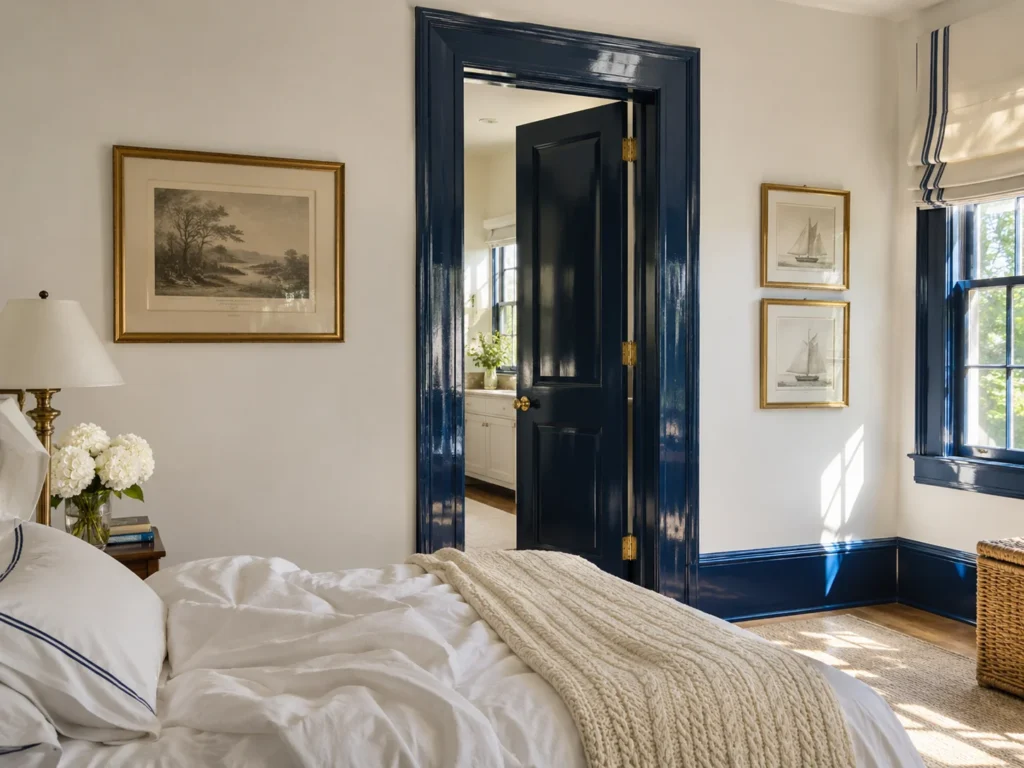
Painting the baseboards, door casing and window trim in a high-gloss navy while the walls stay soft cream is the most tailored move in preppy decorating. Benjamin Moore Hale Navy on the trim with Sherwin-Williams Alabaster on the walls reads as deliberate tailoring rather than color blocking, because the navy is doing the work of a dark suit lapel against a white shirt. The brights stay contained in the lines.
Lacquered trim beside a chunky cable-knit throw is the pairing that keeps this from feeling like a showroom. Hard glossy paint against deep soft wool, two surfaces behaving completely differently.
High-gloss paint is brutally honest about surface prep. Every nail hole, sanding scratch and brush mark shows under that sheen, and a wavy old baseboard will look worse glossy than it did flat. Sand properly, prime, and expect to lay two thin coats rather than one thick one.
For a boxwood green version instead of navy, the undertone rules matter, and these earthy green schemes that stay warm cover picking a green that will not go murky under lamplight. Renters can skip paint and use removable gloss vinyl trim tape, which looks surprisingly convincing at a distance.
Bedroom Blueprint
Room Size: Any. Works especially well at 9 foot ceilings with tall baseboards.
Placement Map: All trim in the room, including the inside face of the door, for the look to land.
Budget Tier: Low.
Calm Score: 8 out of 10.
A Tailored Fabric Waterfall Behind the Headboard
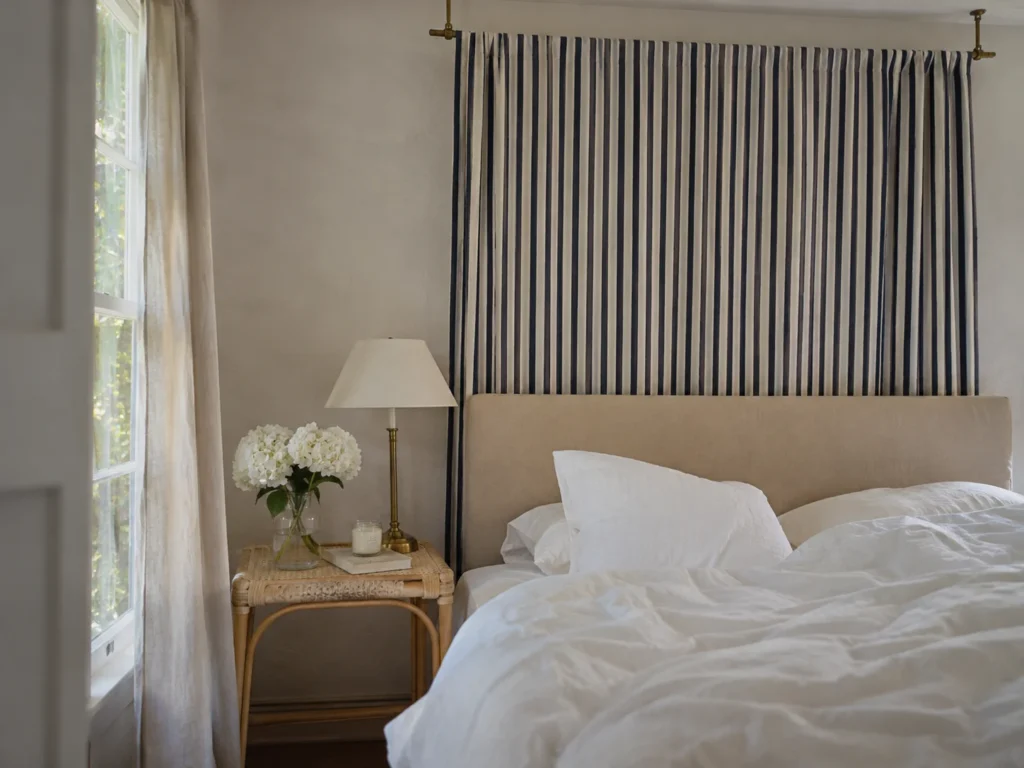
Suspending a panel of vertical ticking stripe linen from a slim ceiling bracket, letting it fall straight down behind the bed, gives you the drama of a canopy without the four posts. A navy and chalk white ticking keeps it tailored, since the narrow repeat reads as texture from across the room rather than as a loud pattern competing with the bedding.
Crisp woven linen against a bleached cane or wicker nightstand is the contrast here. Flat tailored fabric beside open basketweave, both in the same quiet palette.
The bracket has to go into a ceiling joist, not drywall, because a full-height lined linen panel is heavier than it looks and will sag or pull out within weeks otherwise. The fabric also needs enough width to hang without rippling, roughly one and a half times the headboard width, or it looks like a bedsheet taped to the ceiling.
A ceiling-mounted tension track handles a lightweight unlined panel with no drilling at all. Ticking stripe by the yard from any fabric store costs a fraction of a ready-made canopy.
Beadboard Wainscoting Topped With a Working Peg Rail

Beadboard to about two thirds height with a continuous peg rail running along the top turns a plain wall into the most useful surface in the room. Keep both painted the same crisp white as the trim so the wall reads as architecture, then let the hung objects supply the color. Vintage wooden tennis rackets, a straw boater, a canvas tote, all of it earning its place rather than sitting on a shelf as decoration.
Painted beadboard ridges against a woven straw hat brim is the texture pairing, and it happens automatically once you hang things. Smooth repeating wood against loose natural weave.
Pegs that stick out more than about 4 inches will catch your sleeve every single time you walk past, and in a narrow room that gets old fast. Keep the pegs shallow, and put the bulkiest items at the ends of the rail rather than the middle of a walkway.
Beadboard wallpaper painted white is a convincing stand-in, with a real timber rail screwed over the top to hide the seam. For more on getting genuine storage out of wall-mounted rails, these small closet solutions that double your storage cover hook depth and load limits.
The Two-Scale Pattern Rule
Pick one small-scale pattern: ticking stripe, micro-gingham, a narrow pinstripe.
Pick one larger-scale pattern: a plaid, a toile, a botanical.
Everything else in the room stays solid, including the rug.
The failure point: a third pattern at a middle scale. Two scales read as tailored layering, three read as a gift shop. If you want more pattern, repeat one you already have rather than introducing another.
Bespoke Bedding and Textile Architecture
A Box-Pleated Bed Skirt With Grosgrain Ribbon Trim

A box-pleated skirt in chalk white with a navy grosgrain border along the hem hides the frame legs and gives the bottom of the bed a crisp finished edge. The flat pleats are what separate this from a ruffled country version, and the ribbon line pulls your accent color down to floor level where it anchors the whole arrangement.
Crisp percale cotton against the ribbed texture of grosgrain is the pairing, and it happens right at the seam. Smooth flat weave meeting a corded ribbon with real surface to it.
A white skirt sits at exactly the height where a vacuum cleaner, a pet and a pair of shoes all meet it, so the hem greys within a season. Buy washable rather than dry-clean only, and measure your frame height precisely, since a skirt even half an inch too long drags and collects dust.
Iron-on grosgrain ribbon along the hem of a plain white skirt costs a few dollars and takes an evening. Target carries basic box-pleated skirts in Queen and King that take the ribbon treatment perfectly.
A Triple-Sheet Turn-Down With an Embroidered Monogram Cuff

Folding the top sheet back over the blanket to create a wide cuff, then adding a hunter green or navy embroidered monogram on that cuff, is the detail that makes a bed look hotel-tailored rather than simply made. The palette stays crisp white with one dark thread color, which is why it reads sophisticated instead of novelty.
Smooth cool percale against a chunky cable-knit blanket underneath gives you the contrast. The cuff folds over something with real loft, so the tailored line has depth behind it.
A triple-sheet setup has to be remade properly every single morning or it collapses into a rumpled mess, and that is a genuine daily commitment rather than a one-time styling choice. Embroidered thread can also bleed slightly on the first few hot washes, so wash cold the first three times.
Monogramming services at most craft stores cost very little per item, and plenty of American mall embroidery counters will do a single sheet cuff. Thrifted vintage sheets often already carry someone’s monogram, and a matching second initial is easier to add than a full set.
A Micro-Gingham Quilt Folded Over Piped Percale
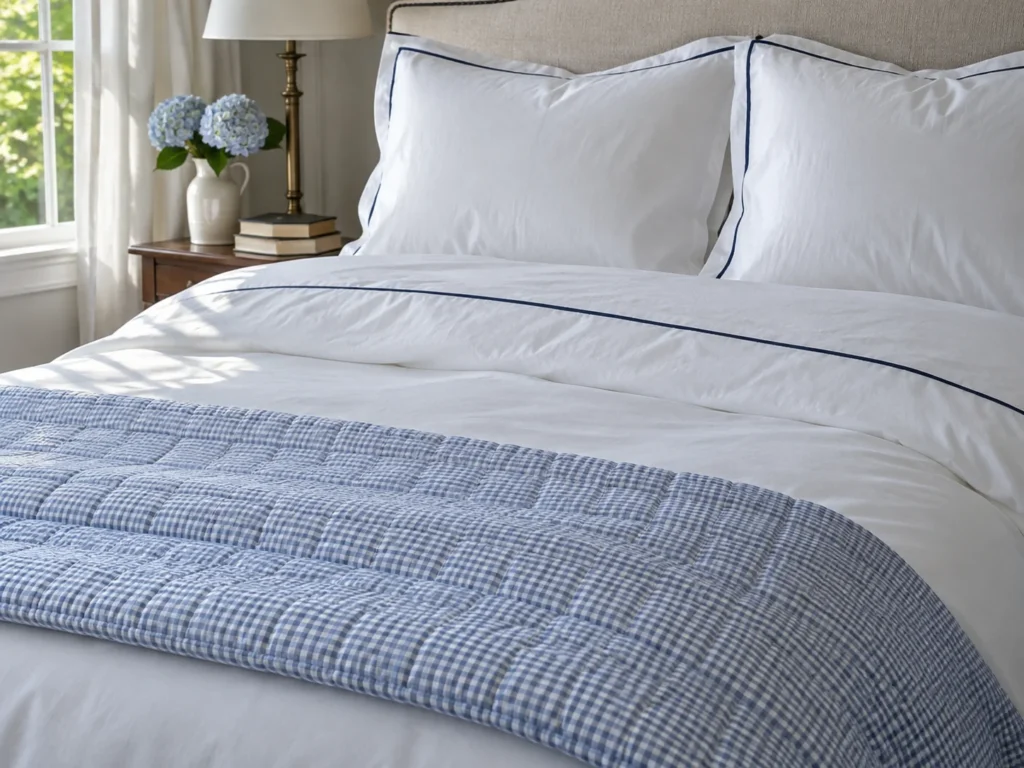
Micro-gingham is the safest pattern in preppy decorating because at a quarter-inch check it reads almost as a solid texture from a few feet away. In French blue or boxwood green over crisp white percale with contrast piping, folded across the bottom third of a Queen, it gives you pattern and tailoring in the same layer.
Flat woven gingham against the raised cord of contrast piping is the pairing. One surface completely smooth, one with a defined edge you can run a finger along.
Piped shams and sheets show everyday makeup and hair product right along the piping line, where the raised cord catches it and holds it. White piping on white bedding is the worst offender. Pick removable washable covers over sewn-shut decorative pieces, and keep a stain stick nearby.
HomeGoods regularly carries gingham quilts at a fraction of boutique pricing. For the broader logic of layering a bed in stages, these master bedroom setups built for two people cover what survives actual nightly use.
Linen Roman Shades Finished With a Tape Border

Roman shades in natural linen with a 2-inch navy tape border down both sides and along the hem are the tailored alternative to curtains, and they are what separates a Palm Beach heritage room from a casual one. The flat fold stack keeps the window crisp, and the tape frames it the way a mat frames a print.
Loose-weave linen against the tight flat tape is the contrast, visible right at the border. Airy and slubby meeting dense and precise.
Roman shades block considerably less light than lined curtains, and a bedroom facing east will wake you at sunrise regardless. Order them with blackout lining if you sleep late, and accept that the fold stack at the top covers 6 to 8 inches of your window even fully raised.
Iron-on twill tape applied to a basic linen shade is the budget route and takes an afternoon. Measure the tape inset carefully, since an uneven border is the one flaw people notice immediately.
Bedroom Blueprint
Room Size: Any, and especially good where curtain panels would crowd a wall.
Placement Map: Mounted outside the frame, extending 2 inches past the casing on each side.
Budget Tier: Mid.
Calm Score: 9 out of 10.
Furniture and Natural Heritage Textures
Lacquered Grasscloth Bedside Tables

Grasscloth wrapped around a nightstand and then lacquered gives you woven texture with a hard wipe-clean shell, which solves the usual problem with natural fiber furniture beside a bed. In a cream base with a tailored boxwood green lacquer, the weave shows through the sheen and reads as heritage rather than rustic.
The glossy lacquered surface against a pleated fabric lampshade sitting on top is the pairing. Hard and reflective under soft and gathered, at exactly the height your eye lands lying down.
Lacquer over a woven substrate telegraphs every bump in the weave, so a cheaply wrapped piece looks cheap under gloss. Check the corners before buying, since that is where the wrap usually fails first. Humidity can also lift the edges over a few years in a bathroom-adjacent bedroom.
Grasscloth peel-and-stick wallpaper applied to a thrifted nightstand, then sealed with two coats of water-based gloss, is the standard flip and costs very little. Prime first or the adhesive will not hold.
A Scalloped Bleached-Cane Headboard

A scalloped top edge is what pushes a cane headboard from generic coastal into something with real Coastal New England character. Bleached cane against a rich wall color, Farrow and Ball Dix Blue or a deep hunter, gives you the pale golden weave as relief against the saturation. The scallop softens all the straight lines a tailored room otherwise has.
Open cane webbing against a lacquered wood frame is the contrast within the piece itself, perforated and matte beside solid and glossy.
Unsealed cane and wicker catch clothing threads, and a loose weave will pull at a knit sweater or snag a sheet corner. Run your hand across the webbing before buying, and seal it with a clear matte finish if it feels at all sharp. Cane also cracks near a forced-air vent, which matters in most American homes.
A thrifted cane headboard sanded and bleached, or a cane room divider panel leaned behind the bed for renters, both work. Coastal palettes suit this well, and these coastal bedroom schemes that avoid the souvenir look cover how far to push the nautical reference before it tips.
An Upholstered Spindle Bench in Cabana Stripe
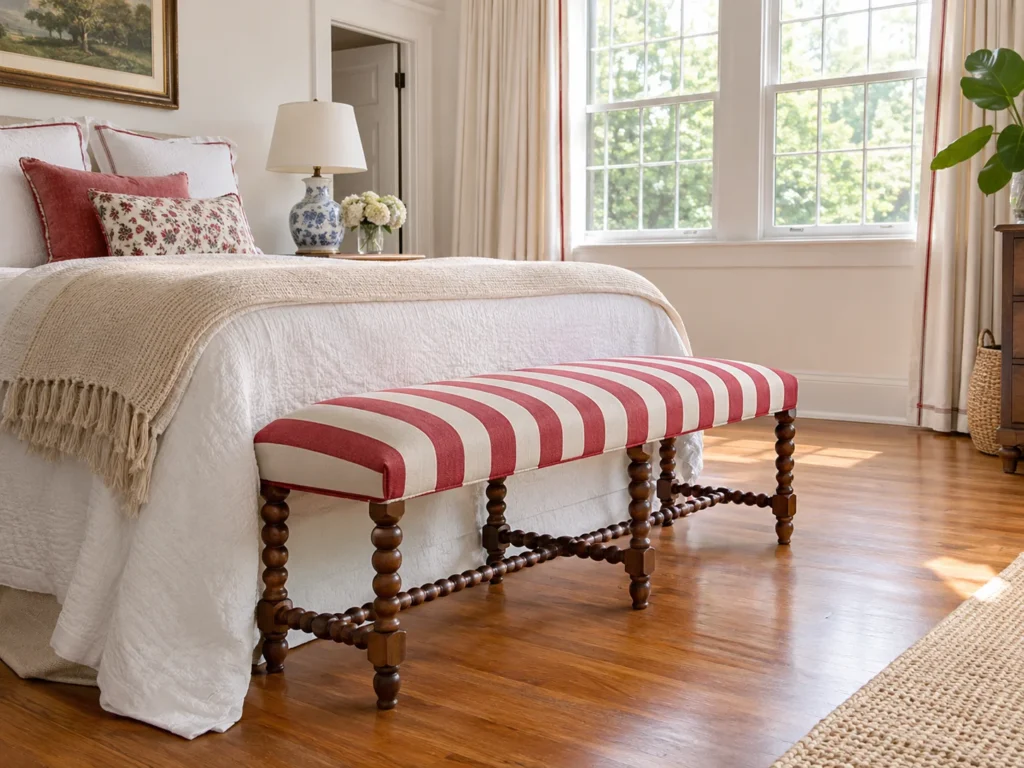
A spindle-leg bench at the foot of the bed, upholstered in a tailored ticking or a wider cabana stripe, is where your larger-scale pattern earns its place. Keep the stripe in two colors only, cream with Nantucket red or French blue, so the scale stays bold without going carnival.
Turned wood spindles against the flat upholstered seat is the pairing, hard and sculpted beneath soft and taut.
Measure the gap between the footboard and whatever sits opposite before buying. A bench plus a 24 inch walkway needs about 40 inches of clear floor, and in a 10 by 10 bedroom with a Queen you often do not have it. Striped upholstery also has to be aligned square to the frame, and a crooked stripe is permanently visible.
A thrifted spindle bench reupholstered with a yard of striped cotton and a staple gun is an evening’s work. Thrift stores are full of spindle benches from the eighties that only need new fabric.
Where the Brights Belong
A trim line: grosgrain on a bed skirt, tape on a roman shade, piping on a sham.
A single piece of upholstery: one bench, one chair, one headboard.
Glossy architecture: casing and baseboards, where the color is contained by shape.
Where they do not belong: four walls. Nantucket red or boxwood green at full saturation across a whole room is the single fastest way to land in dorm territory.
Lighting, Antiques and Collected Accents
Brass Swing-Arm Sconces With Pleated Block-Print Shades
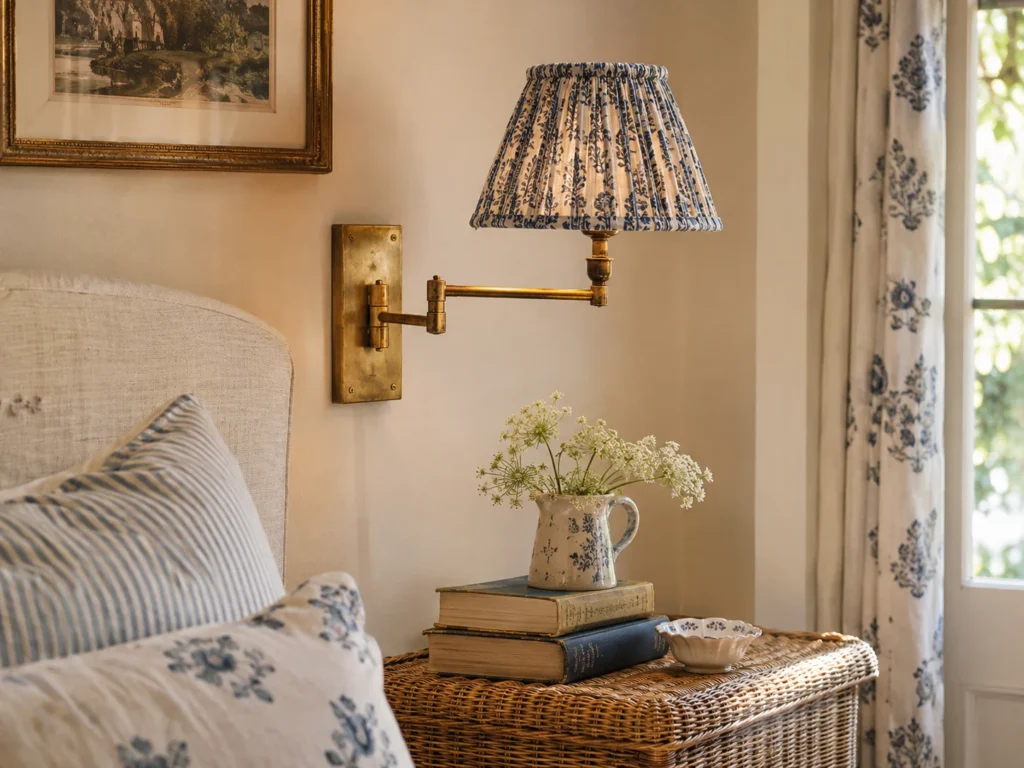
Unlacquered brass swing arms fitted with small pleated shades in a block-print cotton are the detail that signals Southern Grandmillennial more clearly than anything else on this list. The brass warms a crisp white room, and the pleated shade in a tiny block print gives you a third pattern touch at a scale small enough not to count against your two-pattern budget.
Hard polished brass against the soft gathered pleats of the shade is the pairing, and the gap between those two materials is what makes the fixture look collected rather than bought as a set.
Unlacquered brass patinas, so the bright finish you ordered will dull within a year, and that is a decision to make upfront. Small pleated shades also sit close to the bulb, so stick to low-wattage LEDs to avoid scorching pale cotton. Plug-in versions leave a visible cord, so measure to the outlet first.
Clip-on pleated shades fitted to plain brass sconces you already own cost very little, and thrifted brass is usually better quality than new. For how these fit into a full lighting plan, these bedside lamp options for a warmer glow cover placement heights and shade materials.
A Picture Ledge of Pennants, Small Oils and Bamboo Frames

A shallow ledge holding layered vintage felt pennants, a few small thrifted landscape oils and a gilded bamboo frame or two is how you get Classic Ivy League character without it reading as memorabilia. The trick is depth of age, so mix genuinely old pieces with newer ones and let them overlap rather than lining them up.
Stiff wool felt against gilded bamboo is the pairing. Matte and fuzzy beside glossy and ridged, which is exactly the clash that makes a collected arrangement look real.
Shallow ledges topple things, so look for at least 3 and a half inches of depth with a front lip. The bigger risk is quantity. More than about five objects on one ledge stops reading as a collection and starts reading as clutter, which is the exact novelty trap preppy decor falls into.
Thrifted landscape oils cost a few dollars each at most American thrift stores, and dated bamboo frames update instantly with a coat of glossy gold spray paint. Reproduction pennants are cheap, though genuine vintage ones have far better color.
An Oversized Needlepoint Lumbar With a Stadium Plaid Throw
One large needlepoint cushion, botanical or sporting, paired with a heavy stadium wool plaid throw is where the room gets its personality. The needlepoint carries the detail and the plaid carries the larger scale, and because both are traditional crafts in muted heritage colors, neither tips into novelty the way a printed graphic cushion would.
Dense stitched wool needlepoint against the loose brushed nap of the plaid blanket is the pairing. Tight and raised beside soft and fuzzy, both wool, completely different hands.
Needlepoint is wool and it attracts moths, which is a real problem in a bedroom with a closet nearby. Store it away from stored clothing and air it out periodically. Wool plaid throws also pill at the folds within a year or two, so shake them out rather than leaving them creased in the same place.
Needlepoint pillows are one of the great American thrift finds, and hand-stitched vintage ones regularly turn up for a few dollars. Check the back seam for a zipper, since a sewn-shut needlepoint cannot be cleaned easily.
Choosing Your Preppy Sub-Style
Preppy is not one look. Pick your lane before you buy anything, because the four versions below pull in genuinely different directions.
| Sub-Style | Core Color Anchor | Signature Patterns | Furniture Finish | The Tacky Trap |
|---|---|---|---|---|
| Coastal New England | Hale Navy with chalk white | Ticking stripe, micro-gingham | Bleached cane, painted white wood | Literal nautical signage. Anchors and rope motifs turn it into a gift shop. |
| Palm Beach Heritage | Cream with boxwood green | Cabana stripe, palm and botanical | High-gloss lacquer, gilded bamboo | Neon lime or hot pink at full saturation across whole walls. |
| Southern Grandmillennial | Soft cream with French blue | Toile, block print, chintz florals | Honey wicker, antique mahogany | Too many florals at once. Three competing scales reads cluttered, not collected. |
| Classic Collegiate | Warm beige with hunter green | Stadium plaid, tartan, pinstripe | Dark stained oak, leather, brass | Sports memorabilia on every surface. It becomes a dorm room fast. |
Common Styling Mistakes to Avoid
Mixing three loud patterns at the same scale. A wide stripe, a buffalo check and a large floral all competing at equal size is the single most common preppy mistake. Keep one small-scale pattern and one larger one, then let everything else go solid.
Painting four walls in oversaturated hot pink or neon lime. Full-saturation brights read as a dorm room no matter how good the bedding is. Put those colors on a trim line, one piece of upholstery or glossy casing, and keep the walls cream or white.
Skipping natural texture entirely. Crisp cotton plus painted wood plus nothing woven leaves the room feeling flat and slightly synthetic. Honey wicker, bleached cane or lacquered grasscloth is what keeps it from looking like a catalog set.
Buying cheap printed synthetic fabrics. Preppy lives entirely on crispness, and a polyester print will not hold a pleat, take a piped edge or feel right to the touch. Fewer pieces in real cotton and linen beats a full set in synthetic every time.
Frequently Asked Questions
How do you make a preppy bedroom look mature?
Move the color off the walls and onto tailored details, so grosgrain trim, piping, glossy casing and one upholstered piece. Keep the walls cream or white and add real natural texture like wicker or cane. Tailoring is what separates grown-up preppy from a dorm room.
What colors define classic preppy style?
Navy and chalk white is the backbone, with boxwood green, Nantucket red, French blue and hunter green as the traditional accents. The rule is proportion rather than palette. Neutrals carry the large surfaces and the brights appear in small controlled doses.
Can you do preppy decor on a budget?
Preppy is one of the cheapest styles to build secondhand, since needlepoint pillows, spindle benches, bamboo frames and landscape oils are thrift store staples. Iron-on grosgrain ribbon and twill tape add tailored detail to plain white bedding for a few dollars. Spend on crisp cotton and save on everything else.
How do you mix preppy patterns without clashing?
Use two scales only, one small like micro-gingham or ticking and one larger like a plaid or toile. Keep both within the same two or three colors. A third pattern at a middle scale is almost always what makes a preppy room feel noisy.
Final Thoughts
Start with crisp white bedding in real cotton and nothing else. That foundation is what every version of this look is built on, and it is the one place worth spending properly, since percale and linen hold a pleat and a piped edge where synthetics never will.
Then add slowly and secondhand. A needlepoint cushion one month, a spindle bench the next, a thrifted landscape oil after that. Preppy rooms look best when they appear collected over years rather than ordered in one go, and buying gradually is also the only way to keep the pattern count honest.