17 Small Bedroom Closet Ideas That Double Your Storage Without the Clutter
Small closets fail for one structural reason. A single hanging rod sits at chest height, leaving a metre of dead air underneath your shirts and another half metre wasted above the shelf. You are paying rent on that space and storing nothing in it. Three moves fix most of it.
Add a second rod below the first, or a drop-down extender, and your hanging capacity roughly doubles overnight. Reclaim the top shelf with uniform bins that are labelled, because mismatched bags up there become a place things go to disappear.
Then clear the closet floor completely by moving shoes and accessories onto the back of the door or into slim pull-out drawers. A visible floor is what makes a tiny closet read as organized rather than stuffed.
I have lived with a 90cm rental wardrobe and an awkward alcove that was technically a closet, so most of what follows comes from measuring badly, buying wrong, and sorting it out the second time. Here are 17 solutions grouped by where they go to work.
Vertical and Structural Hacks
The Two-Tier Rod That Doubles Your Hanging Space
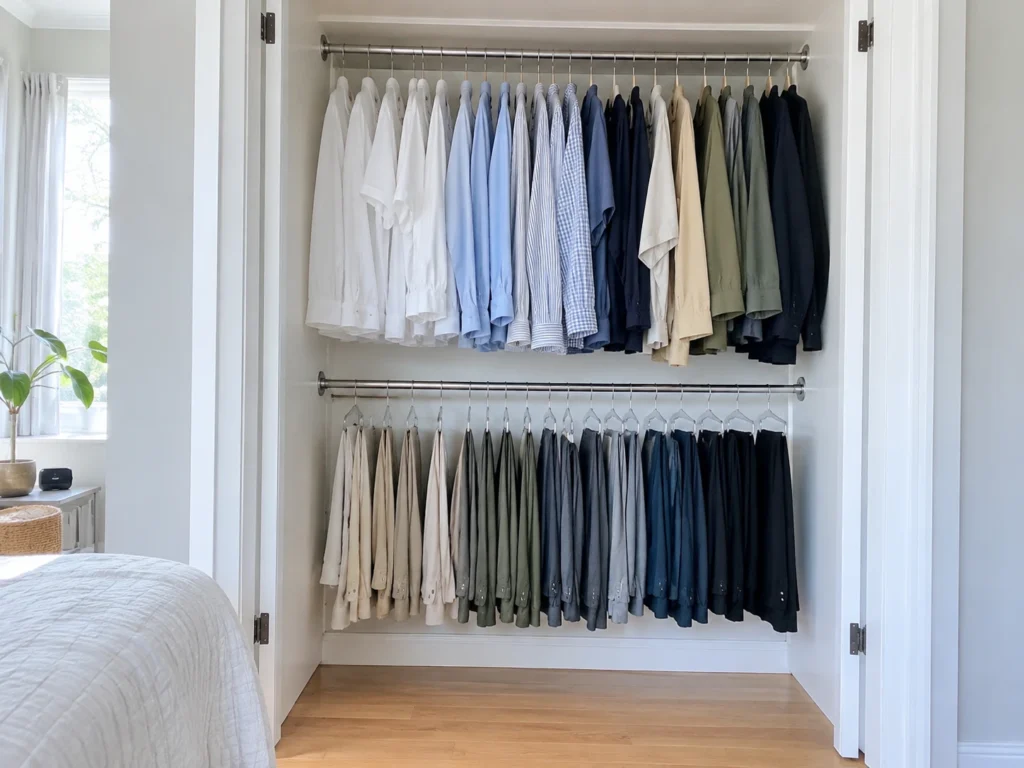
Adding a second rod below the first is the highest-value change you can make. Shirts, folded trousers and skirts all fit comfortably in a 90cm vertical gap, so one closet becomes two. Done well, it looks like a Clean White Modular system from a showroom.
The measurement photos hide is the drop. You need about 100cm from rod to rod for shirts, and roughly 150cm of clear height for full-length dresses or coats. Measure your longest garment first, then give that length its own undivided column on one side.
Renting? A drop-down extender rod hangs off the existing one with two adjustable straps, no drilling and no permanent change. It costs very little and comes out in seconds when you move.
Bedroom Blueprint
Room Size: Any closet with at least 180cm of interior height.
Placement Map: Two-thirds of the width double-hung, one-third left full height for long items.
Budget Tier: Low.
Calm Score: 10 out of 10.
Acrylic Shelf Dividers That Stop the Sweater Avalanche

Clear acrylic dividers slot onto a shelf and turn one wide surface into neat vertical slots. Folded knits stay standing, and the Scandinavian Minimalist look of straight edges and clear material photographs beautifully.
Here is the part staging skips. Dividers only work on shelves of standard thickness, usually under 3cm, and they slide around on melamine unless the fit is snug. Deep shelves are also the real culprit behind messy piles, because anything stacked more than about 30cm back becomes invisible and gets abandoned.
A cheaper route is a row of thrifted wicker or canvas boxes sitting side by side. They do the same dividing job and hide any untidiness inside.
Uniform Bins on the Ultra-High Top Shelf
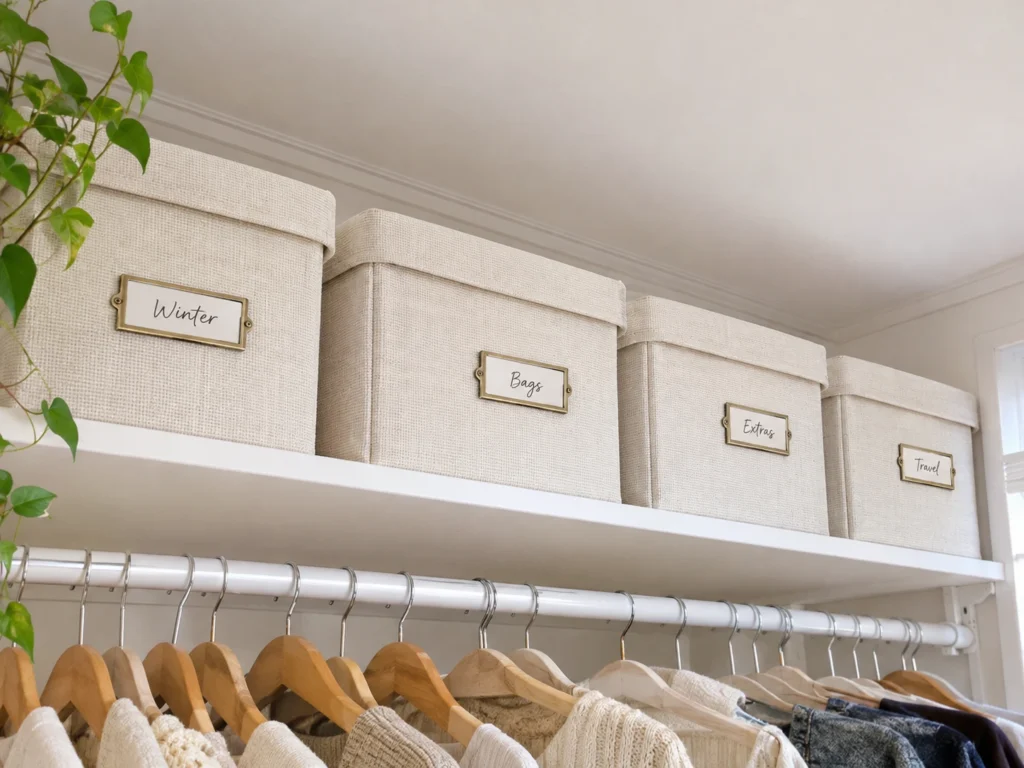
The shelf above the rod is prime storage people waste. Fill it with matching lidded bins holding off-season clothing, spare bedding and luggage, and the top of the closet suddenly looks deliberate instead of chaotic.
Labels are not optional here. Anything above eye level is out of sight within a fortnight, and you will end up pulling down three bins to find one scarf. Write labels on the front face, not the lid, since the lid is the one surface you cannot read from the floor.
Budget version: identical cardboard magazine boxes or fabric cube inserts cost very little, and uniformity matters far more than material for how tidy it reads.
Measure These Four Things Before You Buy Anything
Interior height from floor to shelf, and shelf to ceiling separately.
Interior depth, then subtract 5cm for hanger shoulders so bins actually fit.
Door swing clearance, measured with the door fully open against the wall.
Your longest hanging garment, measured on its hanger from hook to hem.
Swapping Closet Doors for Soft Curtain Drapery

Taking the doors off and hanging a floor-length linen curtain instead is a Japandi Warm Wood favourite. You gain the entire door swing as usable floor, and a soft fabric panel makes a small room feel less boxed in than two hard slabs.
Be honest about what you are giving up. A curtain hides nothing from dust, and the closet contents become part of your room’s visual noise every time it moves. It also does very little for sound or smell from laundry waiting to be washed.
Store the original doors flat under the bed so you can reinstall them when you leave. A tension rod inside the frame holds the curtain with no hardware at all.
Bedroom Blueprint
Room Size: Best in rooms under 10 square metres where door swing matters.
Placement Map: Rod mounted just inside the frame, curtain breaking 1cm above the floor.
Budget Tier: Low.
Calm Score: 8 out of 10.
Behind-the-Door and Wall Maximizers
An Over-the-Door Pocket Station for Shoes and Small Things
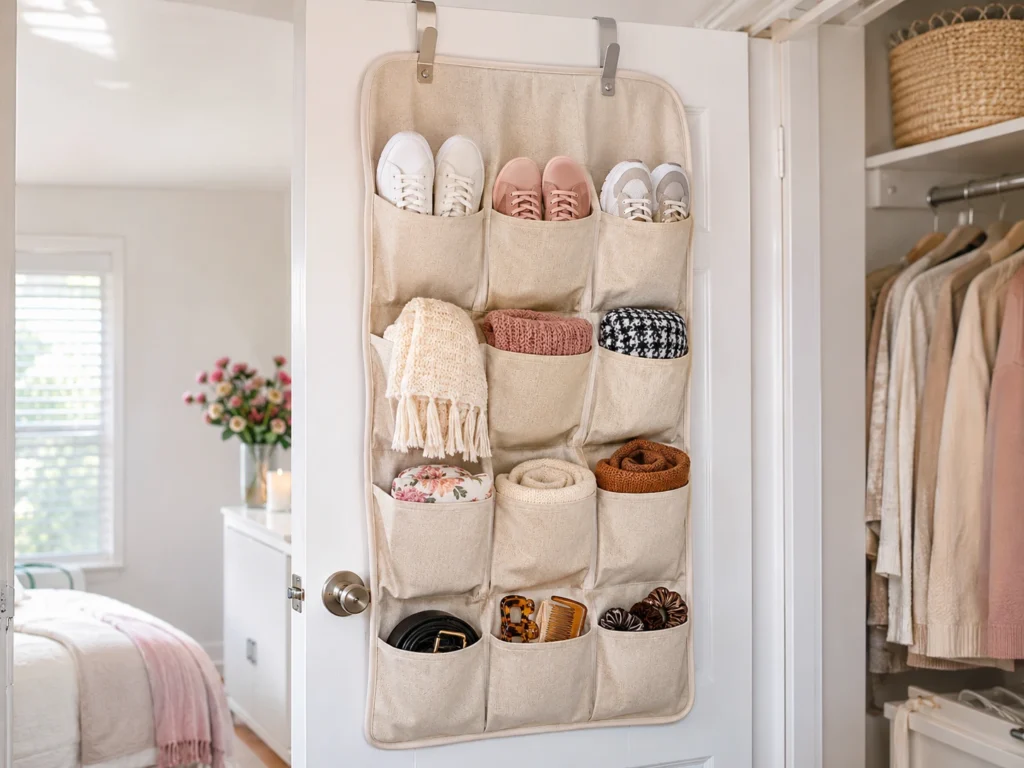
Canvas shoe pockets on the back of the door are the fastest way to clear a closet floor. Twenty-four pockets hold shoes, or scarves, or hair tools, and everything is visible at a glance.
Two practical catches. A loaded organizer adds real thickness, so the door may stop closing flush against a tight frame. And over-door hooks chew the paint on the top edge of the door, which matters in a rental. Slip a strip of felt under each hook.
Where the door will not clear, mount the same organizer on the inside wall of the closet instead, using removable adhesive hooks rated well above the loaded weight.
A Shallow Peg Rail With Hooks for Bags, Hats, Belts and Scarves

A simple wooden peg rail running along the closet’s side wall or the wall just outside it holds everything that refuses to fold. Hats, bags, belts rolled over a hook and scarves looped twice all live happily at eye level, and the warm wood reads as Boutique Hotel rather than utility.
Depth is the thing to get right. A peg sticking out more than about 8cm will catch your sleeve every time you reach past it, and a loaded bag hook inside a narrow closet blocks the rod behind it. Keep pegs shallow and put the bulkiest items at the ends.
Adhesive hooks spaced along the wall do the same job with zero holes. Thrifted brass hooks screwed into a reclaimed timber offcut cost almost nothing and look far better than anything flat-packed. Warm wood tones go a long way here, and these ways to style a bedroom around darker wood help if your furniture is already on the deeper side.
A Pull-Out Valet Rod for Tomorrow’s Outfit
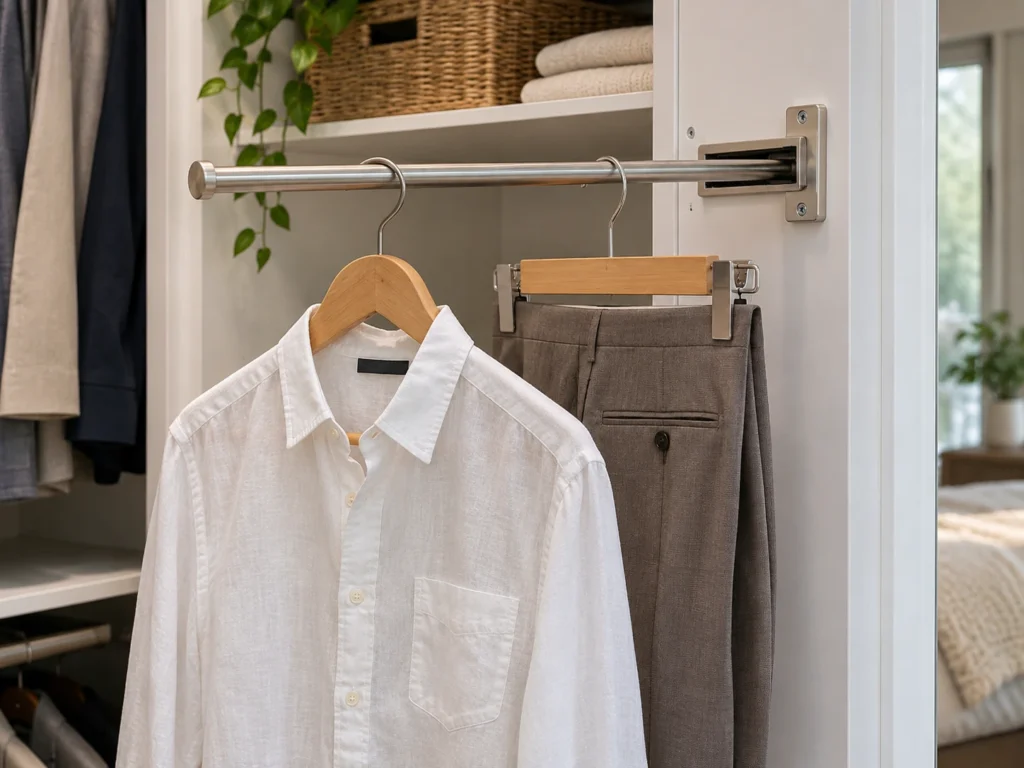
A valet rod is a small metal arm that slides out from the closet side panel and tucks away flat. Hang tomorrow’s outfit on it the night before, and mornings stop involving a pile on the bed.
It needs a solid vertical surface to screw into and about 30cm of clearance to extend. In a very shallow closet, a fully extended valet rod collides with the door, so test the swing before you fix it permanently.
No side panel to mount on? A single sturdy hook on the outside of the closet door does the same job for a fraction of the cost.
Bedroom Blueprint
Room Size: Any closet at least 40cm deep.
Placement Map: Side panel, roughly 160cm from the floor, clear of the hanging rod.
Budget Tier: Low.
Calm Score: 9 out of 10.
Drawer and Modular Insert Solutions
Slim Wire Mesh Sliding Drawers Under the Short Rod

A stack of slim wire drawers tucked beneath the shorter hanging section turns dead floor into real storage. Mesh lets you see the contents without pulling the drawer, which is why it beats solid boxes for daily items.
Wire has a downside worth knowing. Fine knits and tights snag on the mesh edges, and soft items sag through the gaps at the base. Line each drawer with a cheap fabric insert or a sheet of felt and the problem disappears.
Secondhand marketplaces are full of these for very little, since people buy them for one flat and leave them behind in the next.
Stackable Clear Shoe Boxes With Front Openings
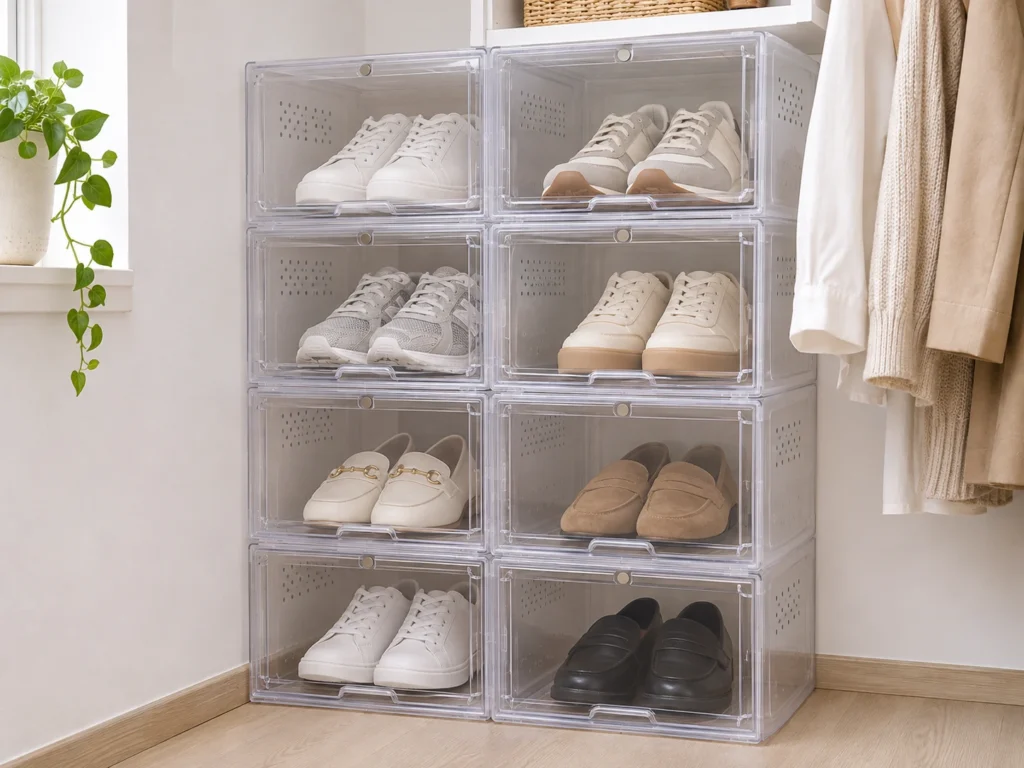
Clear stackable boxes with a drop-front door let you pull one pair from the middle of a stack without dismantling the tower. Stacked six high in a corner, they look crisp and keep dust off everything.
Check the internal dimensions, not the external ones. Standard boxes are sized for roughly a UK size 7, and larger shoes or ankle boots simply do not fit. Tall boots need their own solution entirely.
The low-cost version is keeping the original cardboard shoe boxes and photographing each pair for the end label. Not as pretty behind a glass door, perfectly functional behind a solid one.
Honeycomb Dividers for Socks and Underwear
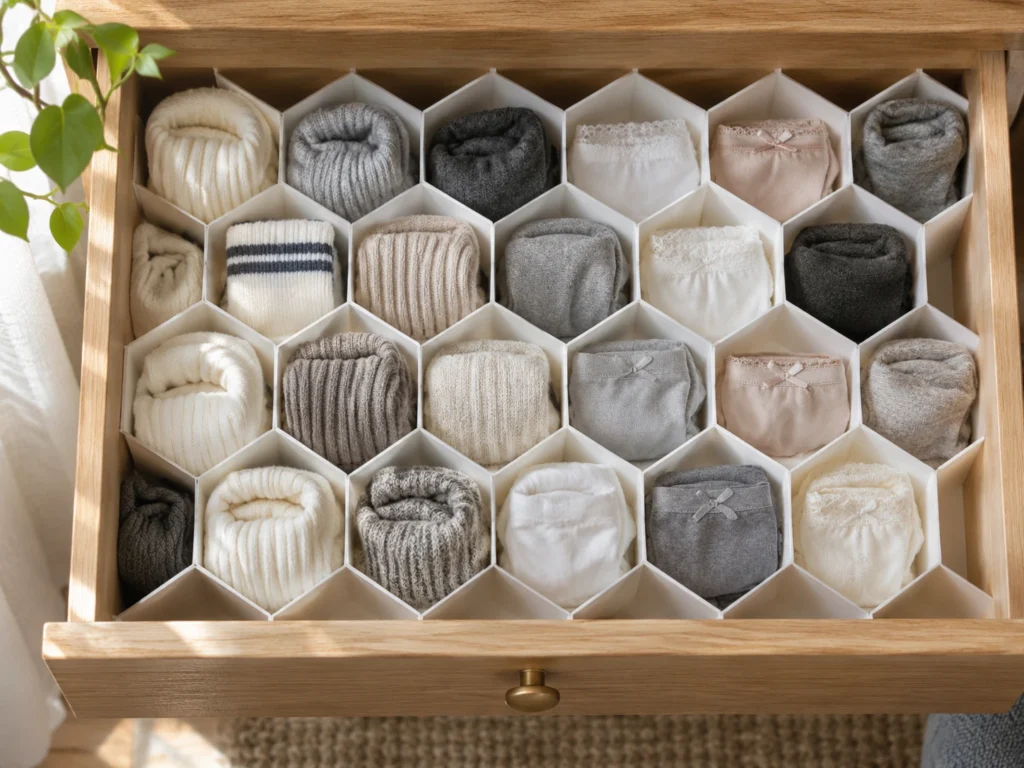
Honeycomb inserts turn a jumbled drawer into a grid of small cells, each holding one rolled pair. It is the single tidiest-looking storage change for the least money, and it survives daily use better than folding ever does.
The cells are sized for rolled items, not folded ones, so you have to change how you put things away. Flexible fabric honeycombs also collapse sideways in a deep drawer unless the grid fills the full width.
Cut-down cereal boxes taped into a grid do exactly the same thing for nothing at all. Nobody opening the drawer will notice.
The Three-Zone Rule for Tiny Closets
Eye level to shoulder: everything you wear weekly. Nothing else earns this space.
Below the knee: shoes, drawers and anything you can bend down for.
Above the shelf: off-season and luggage only, in labelled bins.
If something in the top zone comes down more than twice a month, it is in the wrong zone.
A Rolling Utility Cart Hidden Under Short Garments
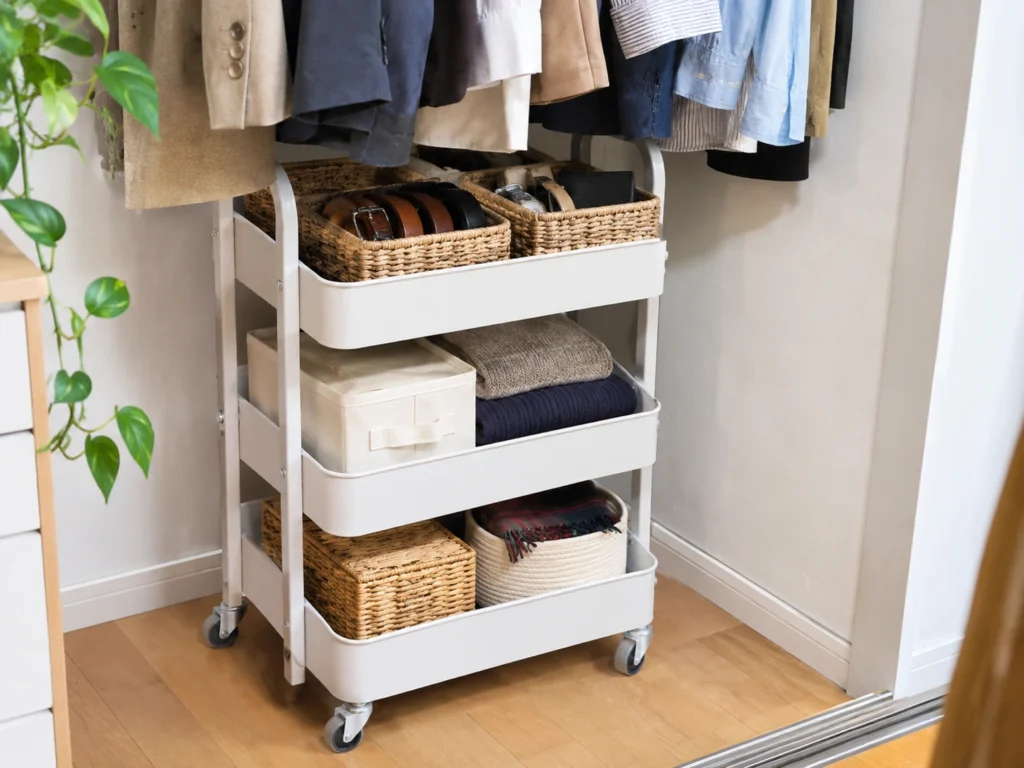
A narrow three-tier rolling cart slides neatly under a row of shirts and pulls out when you need it. It is ideal for accessories, laundry supplies or the gym kit that never has a home.
Measure the cart height against your shortest hanging garment, and allow 10cm of clearance so hems do not drape over the top tier. Carpet also makes small castors nearly useless, which is the detail nobody mentions.
A thrifted wicker basket with a handle does the same job for less, and it looks softer in an open closet.
Open and Alternative Closet Concepts
A Scandinavian Garment Rack in an Awkward Nook
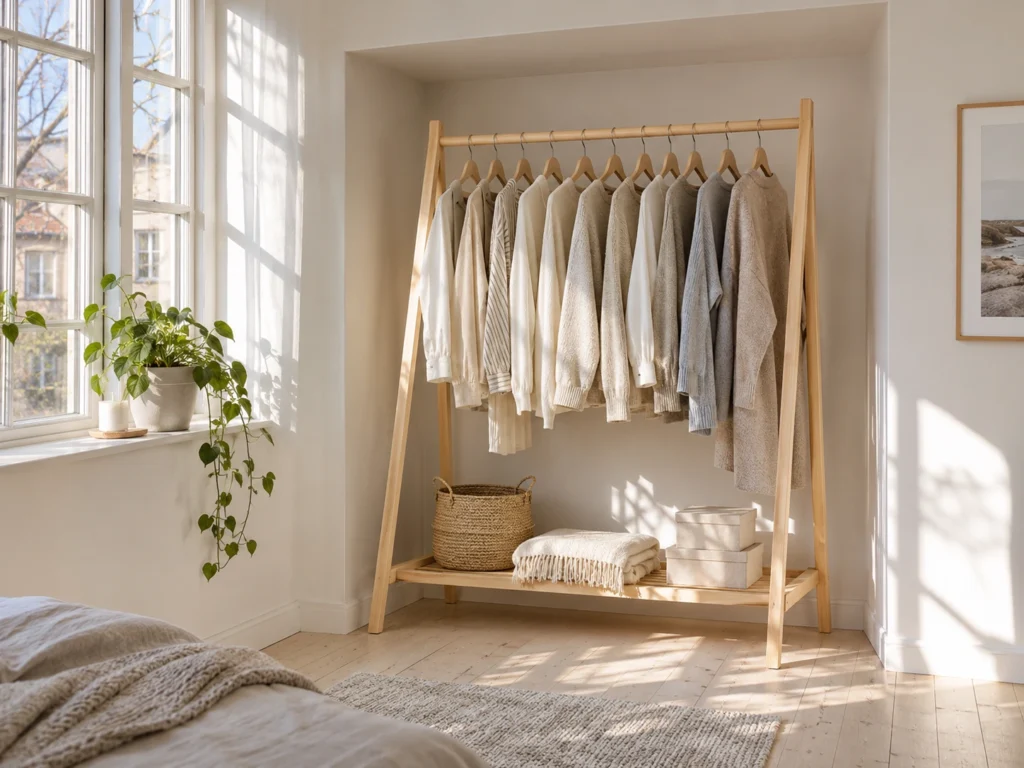
A slim pale wood garment rack slotted into an alcove turns a useless corner into a Boutique Hotel Open Rail moment. Hung with a small, tightly edited selection, it looks intentional rather than overflowing.
Open hanging means everything is on display, so this only works if you keep it to around fifteen pieces in a coherent colour range. Dust settles on shoulders within weeks, and anything hanging near a sunny window will fade.
A tension rod wedged across a narrow alcove costs very little and holds a surprising amount, with no floor footprint at all. Shared rooms get a lot from this approach, and these small shared bedroom layouts show how to split limited hanging space fairly.
Bedroom Blueprint
Room Size: Small rooms with an alcove at least 70cm wide.
Placement Map: Against the shortest wall, away from direct window light.
Budget Tier: Low to mid.
Calm Score: 7 out of 10.
A Ceiling-Hung Brass Pipe or Branch Wardrobe
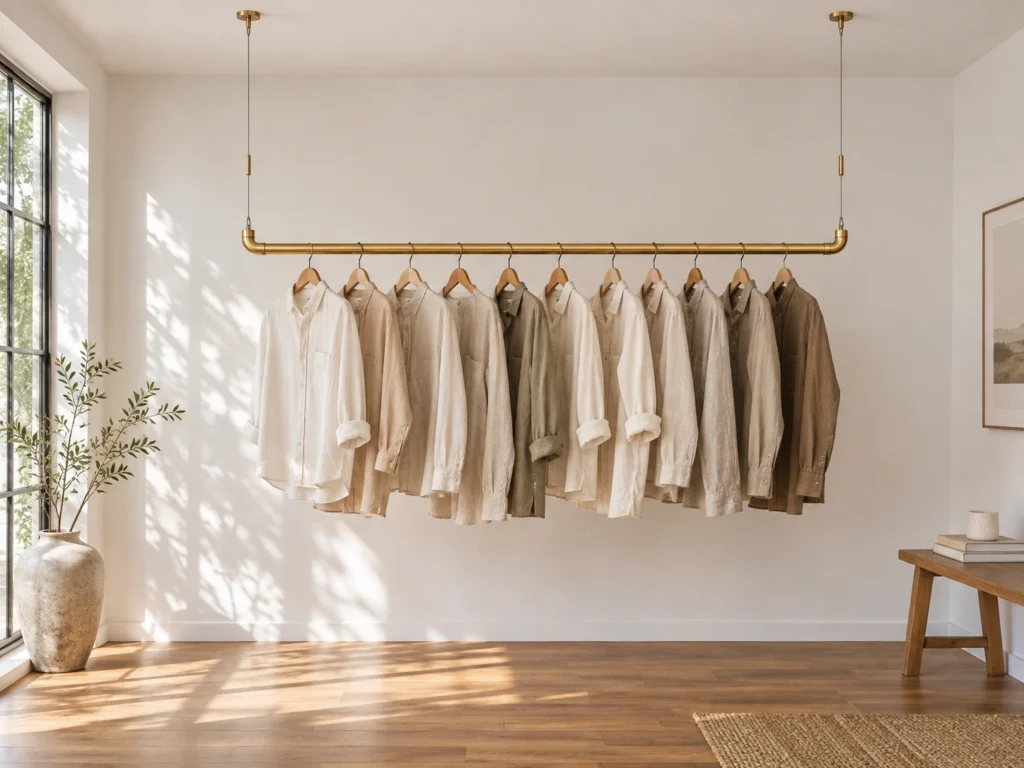
Suspending a brass pipe or a sanded branch from two ceiling hooks gives you hanging storage that touches no floor and no wall. It is the most photographed open-wardrobe idea going, and in a tiny room the floating look genuinely makes the space feel bigger.
This one is only as safe as your ceiling. Hooks must go into joists, not plasterboard, and a full rail of winter coats is heavier than people expect. Find the joists properly before anything goes up, and keep the load modest.
Renters can get a similar effect with a freestanding A-frame rack in the same brass or raw wood finish, with no holes in the ceiling at all.
A Corner Hanging Unit for the Angle Nobody Uses
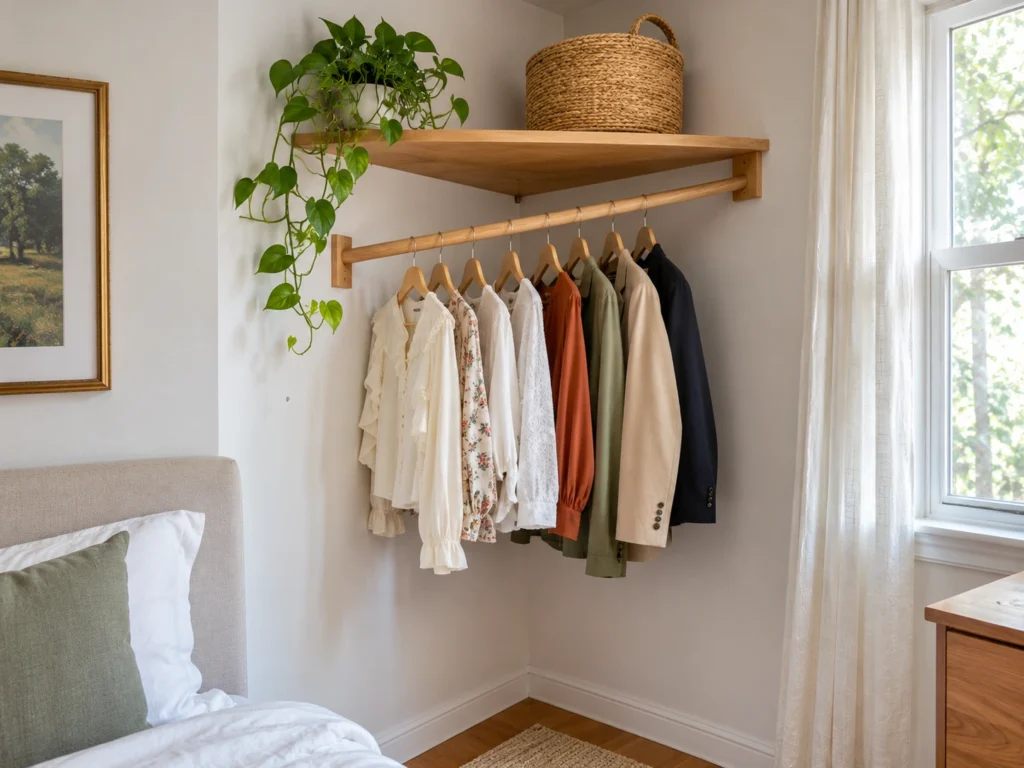
Corners are the most wasted square metre in a small bedroom. A corner-fitted rod bracketed across the two walls, with a shelf above it, converts that dead angle into a genuine second wardrobe.
The geometry is fiddly. Garments hanging in a corner crowd each other at the inner end, so reserve the deepest point for off-season items you rarely reach for. Rooms are also rarely square, so measure both walls separately.
Two corner tension rods meeting at the angle give you the same arrangement with no drilling, as long as you keep the weight light. Corners earn their keep fastest when two people share one room, and these small bedroom setups for two sisters lean on exactly that trick.
Lighting and Finishing Touches
Motion-Sensor Rechargeable LED Strips Inside the Rod
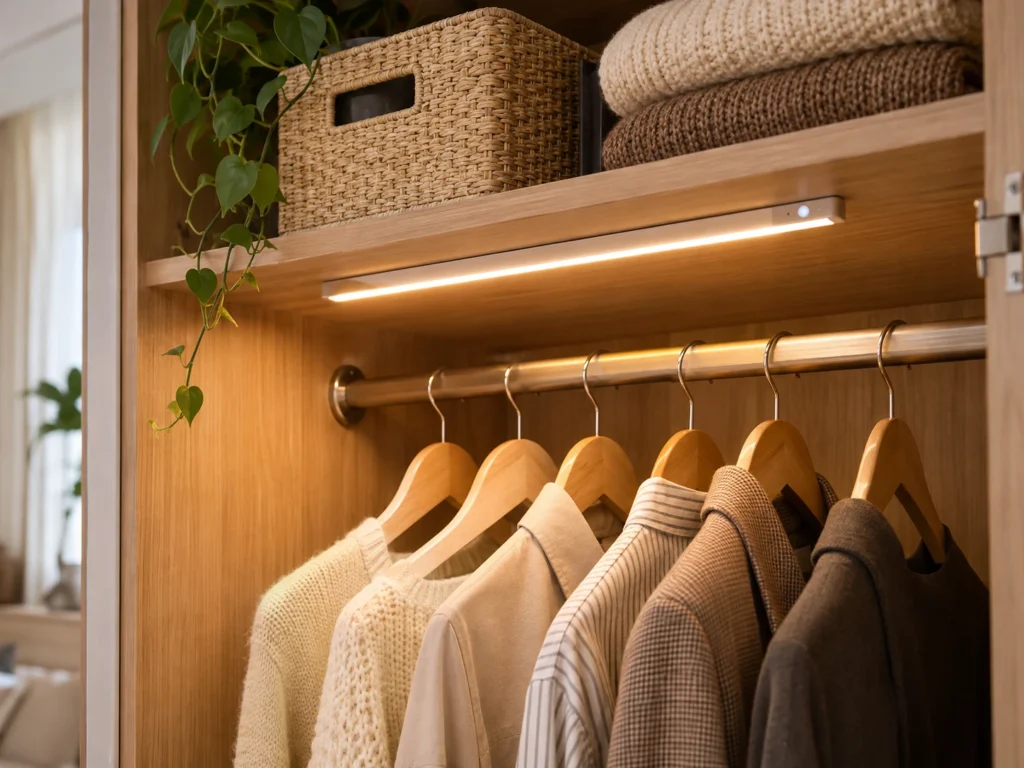
A closet you cannot see into always looks messier than it is. A rechargeable LED strip stuck under the shelf, triggered by motion, lights the whole rod the moment the door opens.
Pick warm white rather than the cool blue-white most sensor strips default to, or your clothes will look a different colour inside the closet than they do in the room. Recharging means unsticking the strip every few weeks, so use magnetic mounting rather than permanent adhesive.
A battery puck light with a tap switch costs a fraction of a strip and lights a small closet perfectly well. This fits the same warm-layers logic as these ways to light a bedroom without the ceiling fixture.
Switching Every Hanger to Matching Slim Velvet

This is the change that makes a closet look professionally organized in twenty minutes. Slim velvet hangers are about a third the thickness of chunky plastic ones, so the same rod holds noticeably more, and the uniform line is what every tidy closet photo has in common.
Velvet grips fabric, which is the point, but it also means silky blouses do not slide along the rod easily and knits can pill slightly at the shoulder over time. Heavy coats are better left on sturdy wooden hangers.
Buy a bulk pack of fifty rather than small sets, which almost always works out cheaper per hanger. Do it in one sitting and bag the old ones immediately, or half of them creep back.
Bedroom Blueprint
Room Size: Every closet, every size.
Placement Map: All rods. Keep wooden hangers only for coats and tailoring.
Budget Tier: Low.
Calm Score: 10 out of 10.
Wallpaper or a Color-Drenched Interior Behind the Clothes
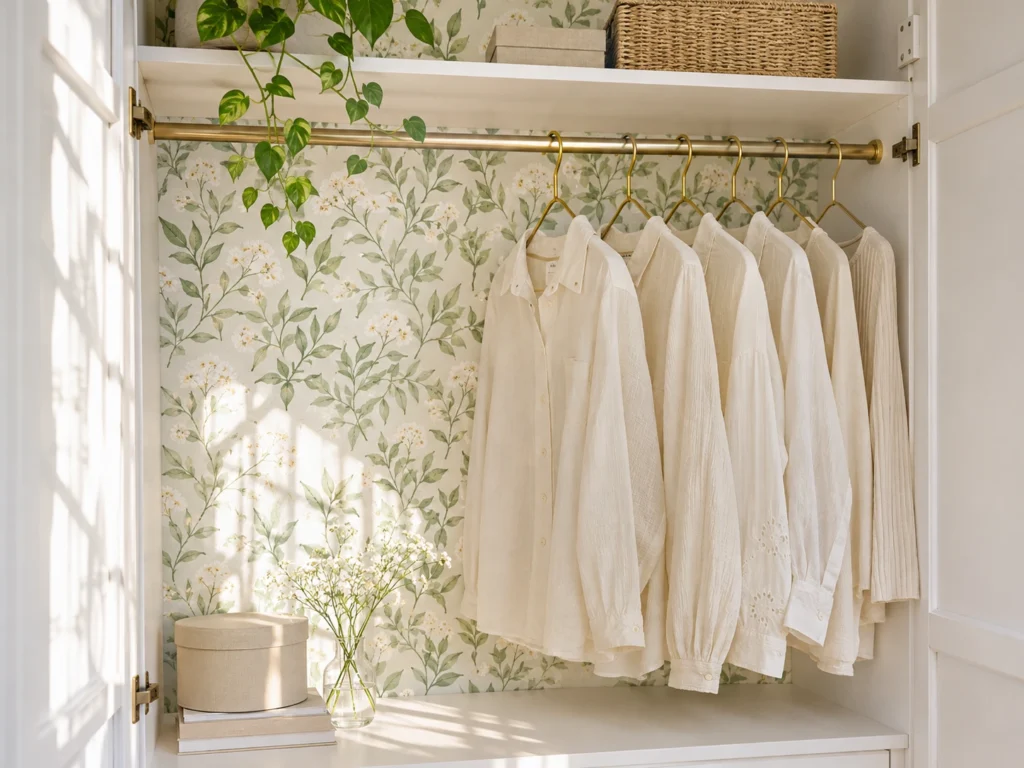
Painting the inside of a closet a deep moody shade, or papering the back wall, turns opening the door into a small pleasure. A Moody Color-Drenched wardrobe in forest green or deep plum makes even a cheap rail look considered.
Dark interiors swallow light, so this idea only works alongside the LED strip above. A very deep colour also makes the space feel smaller, which is a fair trade in a closet you only glance into but not in an open one on display.
Peel-and-stick wallpaper on the back panel is the renter answer, and a single roll usually covers a standard closet. Deeper, richer palettes take this well, as these darker boho bedroom schemes demonstrate.
Comparing Small Closet Organizers
Before you add anything to a basket, check it against the space you actually have. Most returns happen because of depth and door clearance, not quality.
| Organizer | Cost Range | Load and Durability | Layout Caveat for Tiny Spaces |
|---|---|---|---|
| Drop-down extender rod | Budget | Light to medium. Straps stretch under heavy coats. | Needs 180cm interior height to be worth fitting. |
| Fixed second rod | Budget to mid | Heavy. Best long-term option if you can drill. | Leave one full-height column for dresses and coats. |
| Over-door shoe pockets | Budget | Light. Seams give out on heavy boots. | Adds thickness. Door may not close in a tight frame. |
| Wire mesh sliding drawers | Mid | Medium to heavy. Lasts for years. | Needs 45cm depth. Line it or fine knits snag. |
| Stackable clear shoe boxes | Budget to mid | Light. Thin plastic cracks if stacked too high. | Check interior size. Boots and large sizes will not fit. |
| Acrylic shelf dividers | Budget | Light. Can crack if forced onto a thick shelf. | Only fits shelves under roughly 3cm thick. |
| Rolling utility cart | Mid | Medium. Castors are the first thing to fail. | Nearly unusable on carpet. Leave 10cm hem clearance. |
| Ceiling-hung rail | Mid | Heavy, but only if fixed into joists. | Never mount into plasterboard alone. Find the joists. |
| Slim velvet hangers | Budget in bulk | Light to medium. Hooks bend under heavy coats. | Buy fifty at once. Mixed hangers waste rod space. |
Common Styling Mistakes to Avoid
Keeping a mix of chunky plastic, wire and wooden hangers. Bulky mismatched hangers eat roughly a third more rod space than slim ones and make a tidy closet look messy no matter how neatly you hang. Standardize before you buy a single organizer.
Leaving shoes in a pile on the closet floor. A visible floor is what separates organized from crammed, and a floor pile also blocks every drawer or basket you might add later. Shift shoes to the door or into boxes first, then plan the rest.
Buying bins before measuring door swing. Deep bins that fit the shelf perfectly will still be unusable if the door stops them coming out straight. Measure depth with the door open, not just the shelf itself.
Organizing before purging. Buying storage for clothes you no longer wear just relocates the problem into tidier containers. Pull everything out, be honest about what you have worn in the last year, and organize what is left.
Frequently Asked Questions
How do I double the hanging space in a small closet?
Add a second rod below the first, either fixed or as a drop-down extender hung from the existing one. Allow roughly 100cm between rods for shirts and trousers. Leave one column at full height so dresses and coats still have somewhere to go.
What closet organizers work in a rental with no drilling?
Tension rods, drop-down extender rods, over-door organizers and removable adhesive hooks cover almost every need. Freestanding garment racks and rolling drawers handle the rest. Add felt strips under over-door hooks so the paint on the door edge survives.
How do I store off-season clothes in a tiny bedroom?
The shelf above the rod is the right home for them, in matching lidded bins labelled on the front face. Vacuum bags work too, though they crease knitwear badly. Under-bed boxes on wheels are the next best option if the top shelf is full.
Should I take the doors off a small closet?
It helps if the door swing is eating floor space you need, and a curtain softens the room. The trade-off is dust and having your clothes permanently on view. Only do it if you are willing to keep the inside genuinely tidy.
Final Thoughts
Start by taking everything out and being ruthless about what goes back. No rod, bin or divider will fix a closet holding twice what it should, and most people find they free up a third of their space before buying anything.
Then standardize your hangers, and only after that pick one vertical zone to tackle. The floor this weekend, the top shelf the next. Doing it in small sections is what makes the change stick, rather than a single exhausting afternoon that unravels in a month.